
Journal of Civil and Environmental Engineering
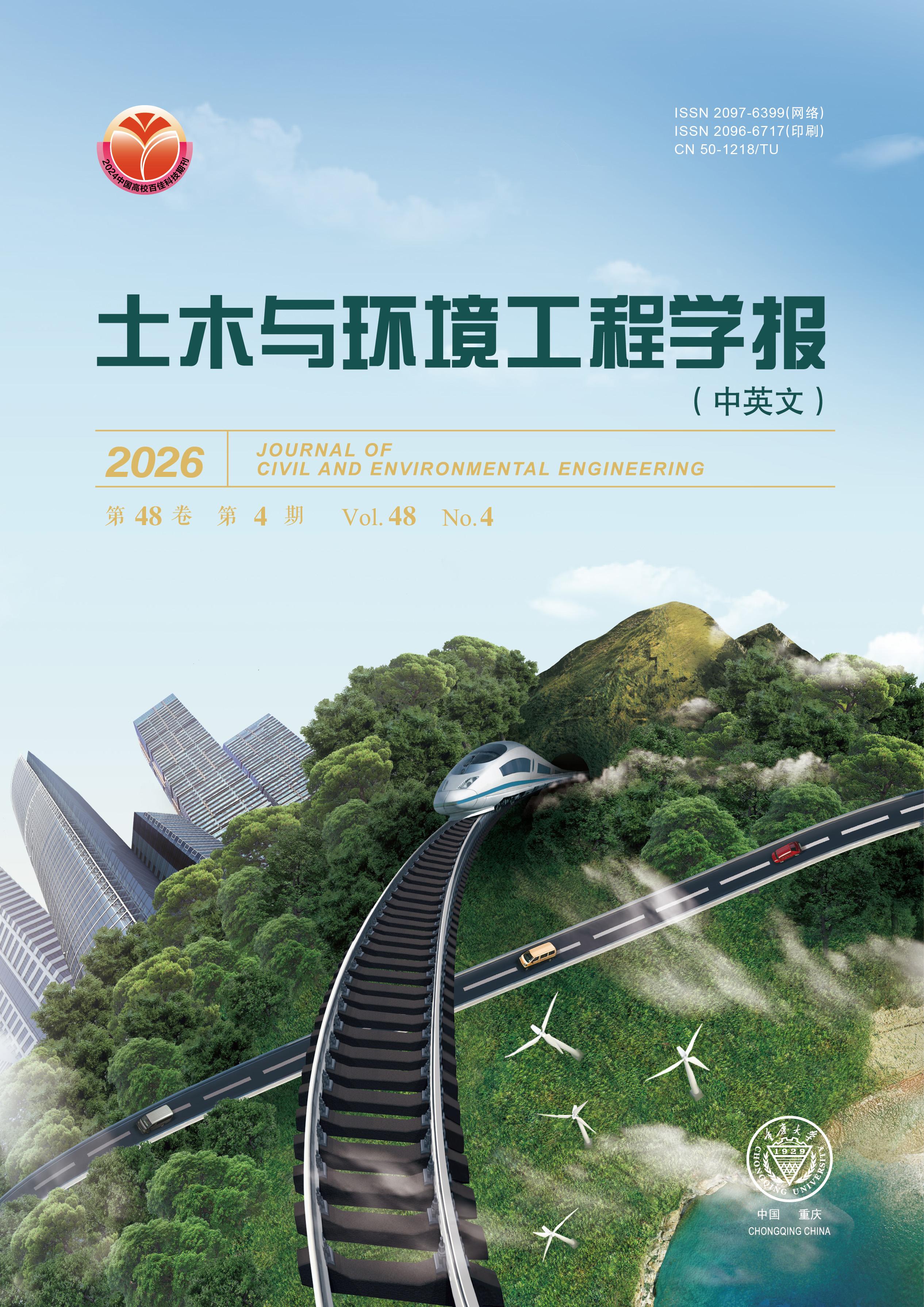
- Editor-in-Chief:LIU Hanlong
ISSN 2097-6399 (Online)
ISSN 2096-6717 (Print)
CN 50-1218/TU - Language: Chinese and English
- Frequency: Bimonthly
- Tel: +86-23-65111322;
- +86-23-65111863
- Fax: +86-23-65102302
- E-mail: xuebao@cqu.edu.cn
Quick Entry
Author Login
Reviewer Login
Editor Login
- Current Issue
- Online First
- Archive
2026年第48卷第5期
Earthquake Disaster Prevention and Mitigation Engineering
摘要:The present study investigates the seismic performance of partially encased composite steel-concrete columns with T-shaped sections (abbreviated as T-PEC columns). Five T-PEC column specimens with different axial compression ratios and main steel component (MSC) configurations are tested under cyclic horizontal load. Furthermore, MSCs are available in various forms, including solid-web steel and honeycomb steel with openings in the steel web. Based on the test and finite element (FE) analysis results, the impact of steel web openings and the axial compression ratio on the seismic performance of T-PEC columns is investigated. The findings indicate that all T-PEC column specimens failed in proximity to the column base, exhibiting plastic softening of the steel flange and adjacent concrete crushing. This is indicative of a typical cross-section compression-bending failure mode. The load-displacement hysteresis curves of all specimens were full, with the hysteresis loops at the same loading level almost coinciding, indicating effective energy dissipation and load-bearing stability. Steel web openings degraded deformability, ductility, and energy dissipation capacity of T-PEC columns. As the axial compression ratio increased, the lateral stiffness and lateral resistance capacity of the T-PEC columns increased, but the deformability, ductility, and energy dissipation capacity decreased. Both the full-section plasticity method and numerical integration method provided reasonably accurate estimates of the flexural capacity of the T-PEC column sections under the action of compression-bending load.关键词:steel-concrete composite column;T-shaped section column;lateral bearing capacity;flexural capacity;stiffness;ductility25|23|0更新时间:2026-10-15Earthquake Disaster Prevention and Mitigation Engineering
摘要:A novel prefabricated reinforced concrete column-steel beam composite joint (PRCSJ) based on tenon-mortise connection is proposed to address seismic resilience issues in prefabricated steel-concrete composite structures. A series of quasi-static tests was conducted on three edge PRCSJ specimens, with the axial compression ratio and the strength of post-cast concrete serving as parameter variables. The objective of this study was to investigate the effects of different parameters on the load-bearing capacity, ductility, energy dissipation capacity, and performance degradation of PRCSJs, and to evaluate the rigidity of the joints. The findings suggest that PRCSJs demonstrated connection failure at the beam end, thereby adhering to the “strong column-weak beam” seismic design principle. The PRCSJs demonstrate plump spindle-shaped hysteresis curves, with distinct elastic, elastic-plastic, and failure stages. The average ductility coefficients range from 2.76 to 4.88 and the equivalent viscous damping coefficients from 0.28 to 0.31, demonstrating good ductility and energy dissipation capacity. The utilization of post-cast ultra-high performance concrete has been demonstrated to enhance the load-bearing capacity of PRCSJs, augment overall joint deformation, and mitigate cracking in the post-cast concrete area. Increasing the axial compression ratio (0.15~0.3) has been shown to enhance the initial stiffness whilst reducing ductility and stiffness degradation capacity of the joints. PRCSJs act as semi-rigid and partial-strength joints under lateral displacement.关键词:prefabricated;composite joint;axial compression ratio;ultra-high performance concrete;rigidity assessment43|41|0更新时间:2026-10-15Earthquake Disaster Prevention and Mitigation Engineering
摘要:In order to evaluate the applicability of commonly used damage-controllable construction methods for masonry-infilled reinforced concrete (RC) frames, a comprehensive pseudo-static test database was established. The database under consideration comprised 63 specimens, which were divided into 17 groups of masonry-infilled RC frames. These groups included bare frames, rigid connections, and damage-controllable specimens. The influence of these construction methods on the mechanical performance of the specimens was systematically analyzed in terms of initial stiffness, maximum load-bearing capacity, displacement ductility, and wall damage patterns. The findings of the present study indicate that damage-controllable construction methods are predominantly concentrated in two areas: the wall-frame interface and the internal structure of the wall. The configuration of the wall-frame interface is intended to mitigate the wall-frame interaction, while the design of the internal structure of the wall seeks to achieve zoning damage control within the wall, thereby improving failure modes. These damage-controllable construction methods can effectively mitigate the excessive initial stiffness and reduce ductility of the specimens observed in traditional rigid connections, albeit at the cost of some load-bearing reserve. Furthermore, compared with the wall-frame interface construction methods, the internal construction methods of the wall show more significant improvements in the displacement ductility, the post-peak mechanical performance, and the damaged area ratio of the specimens, rendering them a preferred choice for enhancing the resilience of the wall.关键词:masonry-infilled wall;damage-controllable;mechanical performance;construction method;wall damage pattern24|22|0更新时间:2026-10-15Earthquake Disaster Prevention and Mitigation Engineering
摘要:Debonded delamination is a typical form of damage to honeycomb sandwich panels (HSPs), which can have a significant impact on the integrity and safety of HSP structures. However, monitoring signals are insensitive to the debonded delamination. In order to address the issues of the wave performance applicability of the deformation-based equivalent model for HSP structures and the difficulty in sensing signal feature extraction for debonded delamination identification, an equivalent conversion method is used by changing an HSP structure into a three-layered periodic structure, and the Comsol Multiphysics software is applied to calculate and draw frequency dispersion curves. The present study investigates the applicability of guided wave performance in the two models by comparing two kinds of finite element (FE) analysis results from the equivalent and actual models of the HSP structure. The FE method is employed to investigate the feature of the debonded-induced-split flow of guided waves. The model tests are used to validate the correctness of the frequency dispersion performance and the debonded-induced-split-flow feature of high-frequency guided waves. The findings indicate that the discrepancy in wave performance between the equivalent conversion and actual models is pronounced, given that the wavelength of the guided wave is less than a single cell height in the HSP. The debonded delamination is the main reason for the debonded-induced-split flow, and it is recommended that the time-domain sensing signals of high-frequency activated A0 mode guided waves are used as extracted features for the debonded delamination identification of HSP structures.关键词:honeycomb sandwich panels (HSPs);ultrasonic guided waves (UGWs);frequency dispersion characteristics;high-frequency guided wave;wave performance;debonded delamination identification18|28|0更新时间:2026-10-15Earthquake Disaster Prevention and Mitigation Engineering
摘要:In order to investigate the influence of environmental humidity on the self-healing performance of damaged ultra-high-performance concrete (UHPC), pre-cracks were induced in the specimens by loading, and then the specimens were subjected to secondary curing in four different environments: continuous immersion, wet-dry cycling, natural curing, and air-tight isolation. Subsequently, a series of rigorous evaluations was conducted, encompassing compressive and flexural tests, along with ultrasonic testing. The self-healing performance of UHPC were evaluated based on several criteria, including its appearance, mechanical properties, compactness, and micro-morphology. The findings indicate that environmental humidity exerts a substantial influence on the self-healing performance of the specimens. The discrepancy in the self-healing rate across varying humidity environments can be attributed to the migration and transportation of water. In water-deficient environments (air-tight isolation and natural curing), no obvious healing products were observed at the cracks of the specimens, and the recovery rates of strength and compactness of the specimens were low. In water-saturated environments (wet-dry cycling and continuous immersion), abundant visible healing products were observed at the cracks in the specimens. These products were composed of calcium hydroxide (Ca(OH)2) and calcium silicate hydrate (C-S-H) gel and were capable of effectively repairing the cracks. The recovery rates of strength and compactness of the specimens were superior in these environments. The recovery rates of strength and compactness of the specimens increased with the damage degree of the specimens. In the continuous immersion environment, compared with the specimens with a damage degree of 70%, the specimens with a damage degree of 90% had an increase of 16.59% in compressive strength recovery rate, an increase of 11.19% in flexural strength recovery rate, and a maximum increase of 64.43% in compactness recovery rate.关键词:ultra-high-performance concrete (UHPC);pre-damage;autogenous healing;ambient humidity;ultrasonic testing45|22|0更新时间:2026-10-15Earthquake Disaster Prevention and Mitigation Engineering
摘要:The addition of large-diameter hyperelastic NiTi shape memory alloy (NiTi-SMA) bars to damping elements has been demonstrated to achive effective self-centring capability. However, given the high sensitivity of SMA materials to temperature, it is important to note that different heat treatment processes can have a certain impact on the mechanical properties of NiTi-SMA bars. This, in turn, can result in varying degrees of influence on the energy dissipation and self-centering ability of dampers or supports containing NiTi-SMA bars. It is therefore essential to conduct a thorough investigation into the impact of diverse heat treatment processes on the mechanical properties of large-diameter NiTi-SMA bars. This article first conducted different heat treatment processes on seven Ni-59.9% at Ti bars with a working section diameter of nine mm, followed by amplified cyclic tensile tests to investigate the effects of different heat treatment processes on the stress-strain relationship, residual strain, energy dissipation capacity, and other properties of the specimens. The research results indicate that appropriate heat treatment can significantly improve the superelasticity of NiTi-SMA bars, with typical flag-shaped stress-strain curves. The present study investigates the effects of heat treatment temperature and duration on the properties of NiTi-SMA bars with a working diameter of nine mm . The results demonstrate that the optimal heat treatment process for these bars is 400 ℃ for 30 minutes. It is observed that as the heat treatment process approaches the optimal value, the energy dissipation capacity, secant stiffness, and equivalent damping ratio of the specimens exhibit increased stability.关键词:shape memory alloy;amplified cyclic tensile test;heat treatment;hyperelasticity;self-centering26|11|0更新时间:2026-10-15

查看更多


- Address:Journals Department, Chongqing University, 174 Shazhengjie, Chongqing 400044, P.R.China Postal code:400044
- Tel:+86-23-65111322 Email:xuebao@cqu.edu.cn
- Technical support is provided by Beijing Founder electronics co., LTD 京ICP备09064830号-19
 京公网安备11010802024621
 - It is recommended to read the content of this site in Chrome&IE9+. Please switch to extreme mode in browser 360.
- Cookies We use cookies to help provide and enhance our service and tailor content. By continuing, you agree to the use of cookies.
0